Former Senator Rod Culleton charge of assault – Withdrawn

Former Senator Rod Culleton charged with assault

Kojonup Police (WA) Constable Matt Johnson received a complaint from the Adelaide/Bendigo Bank agents, Mr. Terrance Kerr, known as the TAB man, claiming the former Senator, Rod Culleton assault him during the attempted theft of a farmers land almost three (3) months ago.

Update: The assault charge was withdrawn, just before very powerful evidence was to be presented by Rodney.

Terrence Kerr of Baycorp is the bailiff arguing with Culleton in the video above.

As a result, Rod Culleton has been charged with assault for defending the farmers property from the corrupt bankers, the bailiff and their accomplices, the WA Kojonup Police.

It’s a seven (7) year maximum gaol sentence for assault, and we all know this is purely about disqualifying Culleton from running in the next federal election under s44(ii) constitution.

“Disqualification; any person who; …for any offence punishable under the law of the Commonwealth or of a State by imprisonment for one year or longer…”

Culleton fought off the bankers and the police for the farmer to remain on the property, where he continues to be in full possession of the farm today. The farmer, Mr. Wayne Manolini even harvested a successful cereal crop estimated to be worth over $800,000 unfettered.

Rod Culleton briefed his supporters today in a Facebook Live.

Posted by GAP in Legal

Crimes against humanity

Crimes against humanity

Definition of crimes against humanity

  1. ‘Crime against humanity’ means any of the following acts when committed as part of a widespread or systematic attack directed against any civilian population, with knowledge of the attack:
  2. Murder;
  3. Extermination;
  4. Enslavement;
  5. Deportation or forcible transfer of population;
  6. Imprisonment or other severe deprivation of physical liberty in violation of fundamental rules of international law;
  7. Torture;
  8. Rape, sexual slavery, enforced prostitution, forced pregnancy, enforced sterilisation, or any other form of sexual violence of comparable gravity;
  9. Persecution against any identifiable group or collectivity on political, medical, racial, national, ethnic, cultural, religious, gender or other grounds that are universally recognised as impermissible;
  10. Enforced disappearance of persons;
  11. The crime of apartheid;
  12. Other inhumane acts of a similar character intentionally causing great suffering, or serious injury to body or to mental or physical health.
  13. For the purpose of paragraph 1:
  14. ‘Attack directed against any civilian population’ means a course of conduct involving the multiple commission of acts referred to in paragraph 1 against any civilian population, pursuant to or in furtherance of a State or organisational policy to commit such attack;

Elements of crimes against humanity

Crimes against humanity do not need to be linked to armed conflict and can also occur in peacetime, similar to the crime of genocide. The definition of crimes against humanity contains the following main elements:

  1. A physical element, which includes the commission of “any of the following acts”:
  2. Murder;
  3. Extermination;
  4. Enslavement;
  5. Deportation or forcible transfer of population;
  6. Imprisonment;
  7. Torture;
  8. Grave forms of sexual violence;
  9. Persecution;
  10. Enforced disappearance of persons;
  11. The crime of apartheid;
  12. Other inhumane acts.
  13. A contextual element: “when committed as part of a widespread or systematic attack directed against any civilian population”; and
  14. A mental element: “with knowledge of the attack”
Posted by GAP in Covid, Legal

Over one thousand scientific studies questioning the safety of COVID-19 vaccines

Over one thousand scientific studies questioning the safety of COVID-19 vaccines

Posted by GAP in Covid
Kaurareg First Nation Tribale Peoples and GAP

Kaurareg First Nation Tribale Peoples and GAP

Kaurareg First Nation Tribale Peoples and Great Australian Party MoU have agreed to work together, support each for the timely restoration of the Commonwealth, and bring back sovereign decision-making control for our tribal peoples.

Posted by GAP in Constitution
Constitution Series: Clause 4

Constitution Series: Clause 4

Constitution series: Covering Clause 4

Commencement of Act.

The Commonwealth shall be established, and the Constitution of the Commonwealth shall take effect, on and after the day so appointed. But the Parliaments of the several colonies may at any time after the passing of this Act make any such laws, to come into operation on the day so appointed, as they might have made if the Constitution had taken effect at the passing of this Act.

The words “of the Commonwealth Bill” point out the influence that Australia had in the creation of The Constitution Act, an act of the United Kingdom (UK) Parliament.

The above is the enabling act that allowed the Colonies/States taking part in Federation to continue to make Laws but only those Laws that they could make after Federation (Reserved and Concurrent powers).

The above words “But the Parliaments of the several colonies may at any time after the passing of this Act make any such laws, to come into operation on the day so appointed, as they might have made if the Constitution had taken effect at the passing of this Act.

All Acts have a date, or a process, that such Act comes into force or takes effect. Most Acts come into force or take effect 28 days after such Act receives Royal Assent. The Constitution Act was different, instead of a date being the method that such Act comes into force or takes effect, there was a process that allowed the Constitution Act to come into force or to take effect and that process was by proclamation.

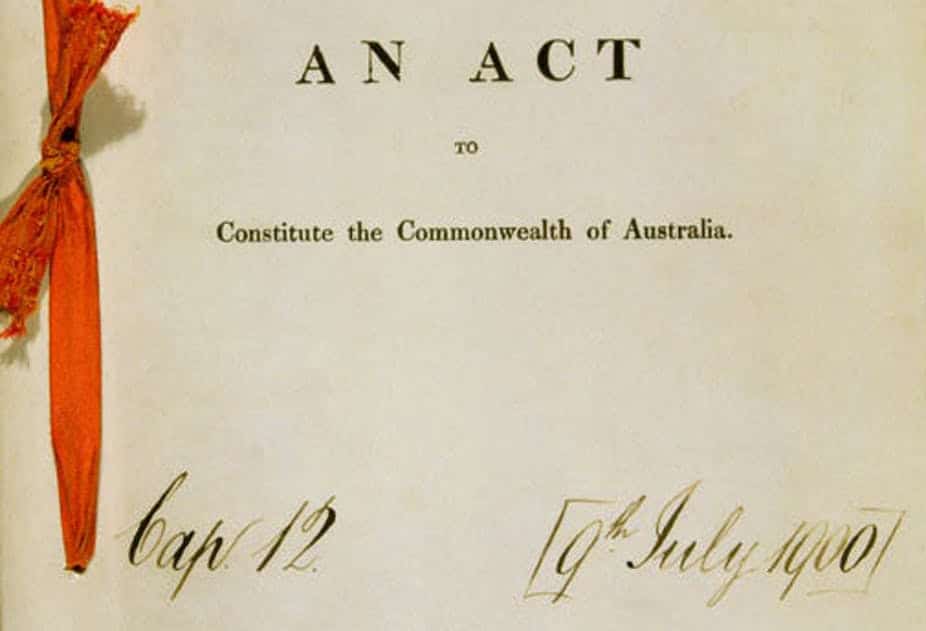
As is described in Covering Clause 3 the process was to declare by proclamation, that, on and after a day therein appointed, not being later than one year after the passing of this Act. In other words, the Constitution Act was created and then assented to on the 9th of July 1900 (the passing of this Act) and the Constitution Act came into effect only after Queen Victoria (the then Monarch) announced by proclamation or if you like, such Act was proclaimed, to come into effect on the 1st January 1901. The time that elapsed in-between was about 5 and ½ Months which was less than one year.

The Annotated Constitution written by Quick and Garran make the following comments;

HISTORICAL NOTE.

—Clause 4 of the Commonwealth Bill of 1891 (which became the Constitution Act 1900) was as follows:—

Unless where it is otherwise expressed or implied, this Act shall commence and have effect on and from the day so appointed in the Queen’s proclamation; and the name ‘The Commonwealth of Australia’ or ‘The Commonwealth’ shall be taken to mean the Commonwealth of Australia as constituted under this Act.

This clause, with the omission of the second word “where,” was adopted at the Adelaide Session, 1897. A provision was then added that “The Parliaments of the several colonies may at any time after the passing of this Act make any such laws, to come into operation on the day so appointed, as they might have made if the Constitution had been established at the passing of this Act.”

Now back to Covering Clause 4 and the Annotated Constitution written by Quick and Garran make the following comments Page 343 to 345.

Shall be Established.

Clause 3 says that the people of the Commonwealth shall be united on and after the day appointed in the Queen’s Proclamation. Clause 4 contains a detailed list and expansion of the legal results of the Union so accomplished. The first immediate result is that the Commonwealth is established.

The word Union refers to the unification of the colonies into becoming firstly States and then the Commonwealth of Australia.

Now back to Covering Clause 4 and the Annotated Constitution written by Quick and Garran make the following comments Page 343 to 345.

Parliament authorizing the creation of colonies, the words “erect” and “establish” are used as identical terms. The Act 9 Geo. IV. (1828) (the Australian Courts Act of 1828), provided that it should be lawful for the King by charters or letters patent under the Great Seal to “erect and establish” courts of judicature in New South Wales and Van Diemen’s Land.

In 1828, all of the area now known as the mainland of Australia was then called New South Wales and the area now known as Tasmania was then called Van Diemen’s Land.

Now back to Covering Clause 4 and the Annotated Constitution written by Quick and Garran make the following comments Page 343 to 345.

The Act (1840) authorized the Queen by letters patent to “erect” into a separate colony or colonies any islands being dependencies of the colony of New South Wales; and by section 3, in case Her Majesty should establish any such new colony or colonies, Legislative Councils might be “established” therein.

The Act (1840) established that Her Majesty could create new colony or colonies.

Now back to Covering Clause 4 and the Annotated Constitution written by Quick and Garran make the following comments Page 343 to 345.

In the first section of the notable Act 13 and 14 Vic, the provision occurs that the territories comprised in the district of Port Phillip should be “erected” into and subsequently form a separate colony to be known as the colony of Victoria (1851).

In the second section of the same Act the words occur “that upon the issuing of such writs for the first election of members of the Legislative Council of the said colony of Victoria such colony shall be considered to be established.

As a result of the Act (1840) that allowed for the creation of the colony of Victoria in 1851. There was other colonies created prior to 1851 and some created after 1851.

Now back to Covering Clause 4 and the Annotated Constitution written by Quick and Garran make the following comments Page 343 to 345.

From these precedents it appears that the word “Established” is the one commonly used to denote the creation of a new State or community.

Shall take Effect.

Another consequence and necessary incident of the Union is that the Constitution shall on the day so appointed “take effect” or come into operation. Here we reach the third and final stage in the progress of political organization contemplated by the Act.

It clearly appears that the Constitution is something distinct from the Commonwealth. The Commonwealth is the community united by the Imperial Act. The Constitution provides the necessary machinery for the government of that community so as to secure its steadiness, safety and development.

The provision of Clause 3 that the Queen may appoint a Governor-General for the Commonwealth at any time after the issue of the Proclamation, and before the actual establishment of the Commonwealth and before the Constitution “takes effect,” is somewhat strange and looks like a speaking out of harmony with the sequence of the other stages. It enables the Queen to appoint a Governor-General, not for an actual existent Commonwealth, not to fill an office created by a constitution actually in force, but for the Commonwealth that is to be, and in order to fill an office that does not yet exist.

May make any such Laws.

At any time after the passing of the Act (the Constitution Act), and therefore before as well as after the day appointed by the Proclamation, the Parliament of each of the federating colonies may proceed to exercise certain powers intended by the Constitution to be conferred upon them.

The above is the enabling act that allowed the Colonies/States taking part in Federation to continue to make Laws, but as said early only those Laws that they could make after Federation (Reserved and Concurrent powers).

Now back to Covering Clause 4 and the Annotated Constitution written by Quick and Garran make the following comments Page 343 to 345.

The Constitution, by which these powers are defined, does not take effect until the day appointed by the Proclamation. In anticipation of that day the Act authorizes the Parliaments to exercise the powers referred to.

Turning to the Constitution we find that the laws referred to by this clause comprise the following:—

  1. Laws prescribing the method of choosing the Senators for a State, and
  2. Laws for determining the times and places of election of Senators for a State, and
  3. Laws for determining the divisions in each State for which  Members of the House of Representatives may be chosen, and the number of Members to be chosen for each division,

To put this into perspective, The Constitution Act was created and then assented to on the 9th of July 1900 and the Constitution came into effect on the 1st January 1901. The paragraphs under the heading “May make any such Laws” allowed the Colonies/States to make Laws but only with the constraints that the new Commonwealth Constitution would apply. The Colonies/States could only use those powers reserved for them and the concurrent powers that both the States and the Federal Parliament (when it came into effect) could make Laws for.


Posted by GAP in Constitution
Informed Vaccination Choice

Informed Vaccination Choice

Letter of response to a workplace

direction to vaccinate:

Former Senator Rod Culleton has drafted a template letter that may

assist in preserving an individual’s right to employment.

Culleton said today he would help offer remedy to individuals being coerced into

receiving a medical procedure to keep their employment.

Download the applicable template letter to your State Below.

THESE FILES ARE IN .DOCX (WORD) FORMAT – YOU WILL NEED

MICROSOFT WORD TO OPEN AND EDIT THEM:

Western Australia

Queensland

Northern Territory

South Australia

New South Wales

Victoria

Australian Capital Territory

Tasmania

“It is the common fate of the indolent to see their rights become a prey to the active. The condition upon which God hath given liberty to man is eternal vigilance; which condition if he break, servitude is at once the consequence of his crime and the punishment of his guilt.

” ~ John Philpot Curran (1750–1817)

(Eternal vigilance is the price of freedom)

s 162(1) Public Health Act 2016 (WA)
s 203(2)
 Public Health and Wellbeing Act 2008 (VIC)
s 362D
 Public Health Act 2005 (QLD)
s 120(4)
 Public Health Act 1997 (ACT)
s 101(2)
 Emergency Management Act 2013 (NT)
s 81
 South Australian Public Health Act 2011 (SA)
s 10
 Public Health Act 2010 (NSW)
s 242(1)
 Work Health and Safety Act 2012 (TAS)
George v Rockett
 [1990] HCA 26; 170 CLR 104; 64 ALJR 384; 93 ALR 483; 48 A Crim R 246
High Court unanimously holds that Queensland Rail is a trading corporation within the
meaning of s 51(xx) of the Constitution
s2
 Constitution Act 1889 (WA)
Corporations (Commonwealth Powers) Act
 2001
s 118
 Commonwealth of Australia Constitution Act 1900 (UK)
Stay of the Emergency Temporary Standard Requiring Mandatory Vaccines or Testing for All Employers (US)
Emergency Temporary Standard Stayed
 by Fifth Circuit Court of Appeals (US)

*”This is not legal advice, just good advice”

by Rod Culleton


New information reveals that there is extra motivation to encourage vaccinations. The following documentation is the official National Partnership on Covid-19 Response which signifies an agreement between the commonwealth of Australia and all states/territories in respect to the response to the novel coronavirus (Covid-19).


NationalPartnershipOnCovid (pdf)


Posted by GAP in Covid

FOI requesting termination of the Great Seal of the Commonwealth refused

FOI requesting termination of the Great Seal of the Commonwealth refused


FOI21-164-FOI-Decision-Letter-with-Attachment (pdf)

On 22 July 2021, Former Senator Rod Culleton wrote to the Attorney-General’s Department to request access to information regarding the Great Seal of the Commonwealth of Australia & its Termination.

Mr. Culleton’s request under the Freedom of Information Act 1982 was as follows:

  1. In light of the letter of Mr. David Lewis, dated 16 August 2021, in response to my request for information, dated 22 July 2021, and my references above, regarding the authority to terminate the Great Seal of the Commonwealth of Australia, I request the instrument that overrides, suspends or terminates the “indissoluble Federal Commonwealth under the Crown of the United Kingdom…” as qualified by the second clause that binds the Crown and the fifth clause that binds the people, that ought to have been in place at the time of 1973 in making the change of authority to the Australian Government.
  2. With reference to termination of the Commonwealth, by substitution of the jurisdiction taken to be solely under the authority of the Australian Government without the Crown, I request the acknowledgement of the Australian people, via the alteration by process of section 128, or otherwise for termination of the Commonwealth and substitution in current practice today.
  3. With reference to termination of the Commonwealth, I request the publication of sufficient notice to the Australian people of that change, in light of the current text of the Constitution and prefacing clauses and in light of the celebration of the centenary of the Commonwealth held in 2001.

Ms. Joanna Baker who is the departments Assistant Director of the Freedom of Information and Privacy Section has signed off and stated:

“Having regard to the above, I am satisfied that reasonable steps to locate the documents to which you have sought access were undertaken. I am also satisfied that the documents do not exist within the department’s records holdings. I have therefore decided to refuse access pursuant to section 24A of the FOI Act.”

Mr. Culleton wanted to bring to the people’s attention, that even though the 1999 republican referendum failed, and that the people chose to stay under the protection of the Crown – contained within our constitution – the government continued to defy the people with the continuation of the defaced Great Seal of the Commonwealth of Australia.

Furthermore, the government deceived the people two years later by claiming to celebrate the Centenary of Federation, having full knowledge that ties to the Commonwealth had been severed.

Watch video on Rumble.

Authorised by Ian Nelson for the Great Australian Party, 65 Cardinal Cct, Caboolture, 4510

Posted by GAP in Constitution

Notice of prohibition to the acting Governor-General

Notice of prohibition to the acting Governor-General

Use this link to sign the notice to the Governor-General

Dear Sir,

I write to you on behalf of my Federal Party, Great Australian Party (GAP) and the wider electorate of the Commonwealth, including but not limited to, its members, having right to legitimate government of the Commonwealth.

In order for such elections to be lawful and proper, writs are to be passed under the Great Seal of the Commonwealth for the endorsement and protection of the Crown in accordance with the foundation law and Her Majesty’s coronation of 1953.

Notices to your pre-successors were made to which answer was returned that you act on the advice of the Australian Government in contradistinction to, and not under the authority of, the Government of the Commonwealth, or the Parliament of the Commonwealth.

Under your term of acting as Head of State, you presided over a discord of the unison of the Commonwealth community where two classes of Australians have developed by the identification of people on the circumstance of a medical condition, vaccinated or not, and application of restrictions upon those who rightfully exercise their private and confidential choice made apart from government oversight.

The Australian people, known as the Commonwealth of Australia, have the right to be informed of the nature of the office of Governor-General established by the Letters Patent and regulated by the Constitution for the Commonwealth. The record shows that no response has been received for disclosure that your office no longer acts for the Commonwealth, as established 1900, but in substitution of it and without lawful instrument.

This notice is drawn and sponsored by the people as electors upon the failure to answer for disclosure the nature of office indicated to be under Queen of Australia, by reference within your Letter of Commission dated May 30 2019, and by reference to the Great Seal of Australia. The meaning of the manner in which you were allegedly commissioned is taken to exclude the exercise of power of Her Majesty within the Commonwealth of Australia.

Unless the otherwise is demonstrated, your failure to make answer and disclose the tenets of office that you hold, it shall be taken that you hold no representation of Her Majesty, as commissions made by the Queen do not include the Great Seal of Australia, nor reference to Queen of Australia. The foundation law establishing the Commonwealth is the current and rightful law for the Australian people including that as recognised by the first people of this land.

You are to forthwith make declaration to the Australian people that you stand down, and having done so, disclose to them the reasons for your action. In fulfilment of the law,

Rodney Norman Culleton

Use this link to sign the notice to the Governor-General

Download the PDF version of this notice

Download the evidence in support of this notice

Posted by GAP in Constitution

AEC and Government Solicitor threaten Great Australian Party with “quantum” fine

AEC and Government Solicitor threaten Great Australian Party with “quantum” fine

Under the title “Authorisation requirements under the Commonwealth Electoral Act 1918 (Cth),” the Australian Government Solicitors have issued the Great Australian Party with a warning letter claiming they are being “instructed to act for the Australian Electoral Commission (AEC)“.

Point 3 of the letter stated:

Each time the unauthorised electoral matter is viewed, the notifying entity (in this case the GAP) may be liable to pay a civil penalty up to $26,640. That is, each time the unauthorised post and/or page is viewed, a penalty of $26,640 can be imposed. For example, we note that the GAP Facebook page has 111,000 followers and has attracted 510 reviews. Depending on the number of times the unauthorised electoral matter on the Facebook page has been viewed, you might be liable for a very significant civil penalty, the precise quantum of which will not be known until the concerns raised by the AEC have been addressed (that is the posts and/or page have been authorised in compliance with the Act).

Furthermore, the Australian Government Solicitors spent Christmas Eve trolling and taking screen shots of the Great Australian Party Facebook Page and emailed a further two (2) “unauthorised” posts they found. We’re not sure if the AEC has given a party this much attention in their entire existence, begging the question is this even normal behaviour?

The letter was signed off by Matthew Blunn

National Leader AGS Dispute Resolution

T 02 6253 7424 M 0407 464 028

matthew.blunn@ags.gov.au

Posted by GAP in Constitution, Covid, Legal